Scientific Journal "Sociology: Theory, Methods, Marketing"
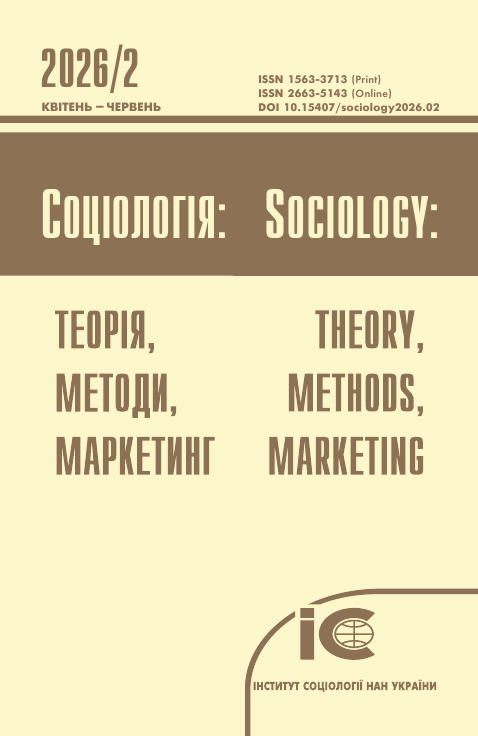
LATEST PRINTED ISSUE
LATEST FREELY ACCESSIBLE MATERIALS
Exclusion and civic participation in wartime: dimensions, risks, and association
stmm. 2026 (1): 25–43
DOI https://doi.org/10.15407/sociology2026.01.025
Full text: https://stmm.in.ua/archive/ukr/2026-1/4.pdf
LINA MALYSH, Doctor of Sciences in Sociology, Associate Professor at the Department of Sociology, National University of Kyiv Mohyla Academy (8/5, Voloska St., Kyiv, 04070)
malysh.lina@ukma.edu.ua
https://orcid.org/0000-0003-3155-3209
The article examines the parameters of exclusion and civic participation in Ukrainian society and their link. The findings are based on data from the Sociological Monitoring «Ukrainian Society» conducted by the Institute of Sociology of the National Academy of Sciences of Ukraine in 2024 (N = 4101).
Exclusion was defined as the lack of scarce resources and opportunities necessary to satisfy individuals' basic needs. The list of scarce resources and opportunities includes health, good housing, essential medical care, good vacation and leisure, and choosing food according to taste. In addition, indicators of the level of exclusion (the number of exclusive scarce resources and opportunities) and its depths (share of the categories of excluded, partially excluded, and included) were calculated.
Civic participation was defined as a set of forms of activity aimed at counteracting the negative consequences of the war, as well as at strengthening the stability of society. There are four of its elements: cognitive (awareness of the situation in the country); affective (responsibility for the future of the country); status (belonging to the category of people affected by the war); and behavioral (set of actions of individuals in military conditions). Twelve configurations of civic participation were identified based on the combination of the elements' gradations.
A significant level and depth of exclusion were found, and the main risk of being excluded was economic deprivation. The level of civic participation was high, especially the levels of its affective and cognitive elements. The main configuration of civic participation was civic help among people with high cognitive engagement, who were weakly affected by the war. The link between exclusion and civic participation was weak; the most substantial differences were observed between several configurations, representing passive and active help strategies.
Keywords: exclusion; level of exclusion; depth of exclusion; risks of exclusion; civic participation; elements of civic participation; configurations of civic participation; construction of indicators
Referenes:
-
Barrett, M., Brunton-Smith, I. (2014). Political and civic engagement and participation: Towards an integrative perspective. Journal of Civil Society, 10(1), 5-28. https://doi.org/10.1080/17448689.2013.871911
-
Bekeshkina, I. (2019). Ukrainian civil society: self-assessment and diagnostics. [In Ukrainian]. Sociology: Theory, Methods, Marketing, 3, 18-21.
-
Carrino, L., Farnia, L., Giove, S. (2024). Measuring social inclusion in Europe: a non-additive approach with the expert-preferences of public policy planners. Journal of the Royal Statistical Society. Series A: Statistics in Society, 187(1), 231-259. https://doi.org/10.1093/jrsssa/qnad106
-
Chen, W., Lu, J., Liu, L., Lin, W. (2014). Gender differences of empathy. Advances in Psychological Science, 22(9), 1423-1434. https://doi.org/10.3724/SP.J.1042.2014.01423
-
Cnaan, R. A., Park, S. (2016). The multifaceted nature of civic participation: A literature review. Voluntaristics Review, 1(1), 1-73. https://doi.org/10.1163/24054933-12340001
-
Costas, J., Prokhorova, A., Stepanenko, V., Sudyn, D., Yermolenko, V., Zaremba-Kosovych, H. (2025). Academic activism in time of war: Voices from Ukraine. Organization, 32(5), 760-771. https://doi.org/10.1177/13505084241284487
-
Cuesta, J., López-Noval, B., Niño-Zarazúa, M. (2024) Social exclusion concepts, measurement, and a global estimate. PLoS ONE, 19(2), e0298085. https://doi.org/10.1371/journal.pone.0298085
-
Dembitsky, S. (2024). Sociological Monitoring «Ukrainian Society»: Changes in Public Opinion During the War. [In Ukrainian]. Retrieved from: https://www.facebook.com/photo?fbid=530109772903971&set=pcb.530114612903487
-
Dembitsky, S. (2025). Model of National Resiliance in the Space of Social Configurations: Essays. [In Ukrainian]. Retrieved from: https://isnasu.org.ua/analytics/010_Dembistkiy_-_Model_natsionalnoi_stijkosti.php
-
Dembitsky, S.S. (2019a). Attitudes towards civic activity and other components of political consciousness in different electoral groups on the eve of the second round of the presidential elections of Ukraine in 2019. [In Ukrainian]. Sociology: Theory, Methods, Marketing, 3, 28-30.
-
Dembitsky, S.S. (2019b). Attitudes towards civic activity in Ukraine: analysis of indicators of main socio-demographic groups (2016 and 2018). [In Ukrainian]. Bulletin of NTUU KPI. Political Science. Sociology. Law, 1(41), 6-16. https://doi.org/10.20535/2308-5053.2019.1(41).194406
-
Doolittle, A., Faul, A.C. (2013). Civic engagement scale: A validation study. Sage Open, 3(3), 1-7. https://doi.org/10.1177/2158244013495542
-
Fedinec, C. (2023). The Ukrainian civil volunteer movement during wartime (2014-2022). Ukraine's Patronal Democracy and the Russian Invasion: The Russia-Ukraine War, 1, 331-352. https://doi.org/10.1515/9789633866641-013
-
Gyan, C. (2021). Community development participation scale: A development and validation study. Community Development, 52(4), 459-472. https://doi.org/10.1080/15575330.2021.1885049
-
Hashidate, H., Shimada, H., Fujisawa, Y., Yatsunami, M. (2021). An overview of social participation in older adults: concepts and assessments. Physical Therapy Research, 24(2), 85-97. https://doi.org/10.1298/ptr.R0013
-
Karakoc, E. (2013). Economic inequality and its asymmetric effect on civic engagement: Evidence from post-communist countries. European Political Science Review, 5(2), 197-223. https://doi.org/10.1017/S1755773912000100
-
Koster, M., Nakken, H., Pijl, S.J., van Houten, E. J., Lutje Spelberg, H.C. (2008). Assessing social participation of pupils with special needs in inclusive education: The construction of a teacher questionnaire. Educational Research and Evaluation, 14(5), 395-409. https://doi.org/10.1080/13803610802337657
-
Lancee, B., Van de Werfhorst, H. G. (2012). Income inequality and participation: A comparison of 24 European Countries. Social Science Research, 41(5), 1166-1178. https://doi.org/10.1016/j.ssresearch.2012.04.005
-
Liubyva, T. (2019). Sociological portrait of members of public organizations. [In Ukrainian]. Sociology: Theory, Methods, Marketing, 3, 26-28.
-
Marlier, E., Atkinson, A.B. (2010). Analyzing and measuring social inclusion in a global context. Journal of Policy analysis and Management, 29, 285-304. https://doi.org/10.1002/pam.20492
-
Nekoei, A., Sinn, F. (2021). Social Inclusion: Definition and Measurement. SSRN, July 26. Retrieved from: https://ssrn.com/abstract=3893489 https://doi.org/10.2139/ssrn.3893489
-
Newton, K., Giebler, H. (2008). Patterns of participation: Political and social participation in 22 nations. Discussion Paper, Berlin, July 2008. Retrieved from: https://nbn-resolving.org/urn:nbn:de:0168-ssoar-197146
-
Oksamytna, S., Khmelko, V. (2004). Social exclusion in Ukraine at the initial stage of the restoration of capitalism. [In Ukrainian]. Sociology: Theory, Methods, Marketing, 3, 66-77.
-
Pantazis, C., Ruspini, E. (2006). Gender, poverty and social exclusion. In: Poverty and Social Exclusion in Britain (ch. 13). Bristol, UK: Policy Press. https://doi.org/10.56687/9781447366843
-
Park, J., Hong, A.J. (2025). Development and validation of civic engagement scale. Humanities and Social Sciences Communications, 12(1483), 1-18. https://doi.org/10.1057/s41599-025-05837-1
-
Reznik, O. (2019). The problem of sociological dimensions of civil society in Ukraine. [In Ukrainian]. Sociology: Theory, Methods, Marketing, 3, 12-15.
-
Savelyev, Yu.B. (2013). Participation as expression of social inclusion in the process of modernization: Ukraine in the European context (1999-2010). [In Ukrainian]. Ukrainian Socium, 2(45), 77-98. https://doi.org/10.15407/socium2013.02.077
-
Silver, H. (2010). Understanding Social Inclusion and Its Meaning for Australia. Australian Journal of Social Issues, 45(2), 183-211. https://doi.org/10.1002/j.1839-4655.2010.tb00174.x
-
Stepanenko, V.P. (2025). Sociological studies of the current state and dynamics of solidary social interactions in wartime: Based on the materials of the report at the meeting of the Presidium of the NAS of Ukraine, March 5, 2025. [In Ukrainian]. Bulletin of the National Academy of Sciences of Ukraine, 5, 45-53.
-
UNDP Ukraine. (2011). Towards Social Inclusion. National Human Development Report. Kyiv: UNDP.
-
UNDP. (2011). Beyond Transition: Towards Inclusive Societies. Regional Human Development Report. Bratislava: UNDP Regional Bureau for Europe and the CIS.
-
UNICEF Ukraine. (2024). Socio-Economic Status of Households in Ukraine (Based on the Results of the Nationwide Sample Survey of the Socio-Economic Status of Households, Conducted in December 2023 - February 2024). [In Ukrainian]. Retrieved from: https://www.unicef.org/ukraine/media/46041/file/%D0%A1%D0%BE%D1%86%D1%96%D0%B0%D0%BB%D1%8C%D0%BD%D0%BE-%D0%B5%D0%BA%D0%BE%D0%BD%D0%BE%D0%BC%D1%96%D1%87%D0%BD%D0%B8%D0%B8%CC%86%20%D1%81%D1%82%D0%B0%D0%BD%2025.07.24%20(1).pdf.pdf
- Weber, P.S., Weber, J.E., Sleeper, B.R., Schneider, K.L. (2004). Self-efficacy toward service, civic participation and the business student: Scale development and validation. Journal of Business Ethics, 49(4), 359-369. https://doi.org/10.1023/B:BUSI.0000020881.58352.ab
Received 28.10.2025
Accepted for publication after review 12.12.2025
Exclusion and civic participation in wartime: dimensions, risks, and association
stmm. 2026 (1): 25–43
DOI https://doi.org/10.15407/sociology2026.01.025
Full text: https://stmm.in.ua/archive/ukr/2026-1/4.pdf
LINA MALYSH, Doctor of Sciences in Sociology, Associate Professor at the Department of Sociology, National University of Kyiv Mohyla Academy (8/5, Voloska St., Kyiv, 04070)
malysh.lina@ukma.edu.ua
https://orcid.org/0000-0003-3155-3209
The article examines the parameters of exclusion and civic participation in Ukrainian society and their link. The findings are based on data from the Sociological Monitoring «Ukrainian Society» conducted by the Institute of Sociology of the National Academy of Sciences of Ukraine in 2024 (N = 4101).
Exclusion was defined as the lack of scarce resources and opportunities necessary to satisfy individuals' basic needs. The list of scarce resources and opportunities includes health, good housing, essential medical care, good vacation and leisure, and choosing food according to taste. In addition, indicators of the level of exclusion (the number of exclusive scarce resources and opportunities) and its depths (share of the categories of excluded, partially excluded, and included) were calculated.
Civic participation was defined as a set of forms of activity aimed at counteracting the negative consequences of the war, as well as at strengthening the stability of society. There are four of its elements: cognitive (awareness of the situation in the country); affective (responsibility for the future of the country); status (belonging to the category of people affected by the war); and behavioral (set of actions of individuals in military conditions). Twelve configurations of civic participation were identified based on the combination of the elements' gradations.
A significant level and depth of exclusion were found, and the main risk of being excluded was economic deprivation. The level of civic participation was high, especially the levels of its affective and cognitive elements. The main configuration of civic participation was civic help among people with high cognitive engagement, who were weakly affected by the war. The link between exclusion and civic participation was weak; the most substantial differences were observed between several configurations, representing passive and active help strategies.
Keywords: exclusion; level of exclusion; depth of exclusion; risks of exclusion; civic participation; elements of civic participation; configurations of civic participation; construction of indicators
Referenes:
-
Barrett, M., Brunton-Smith, I. (2014). Political and civic engagement and participation: Towards an integrative perspective. Journal of Civil Society, 10(1), 5-28. https://doi.org/10.1080/17448689.2013.871911
-
Bekeshkina, I. (2019). Ukrainian civil society: self-assessment and diagnostics. [In Ukrainian]. Sociology: Theory, Methods, Marketing, 3, 18-21.
-
Carrino, L., Farnia, L., Giove, S. (2024). Measuring social inclusion in Europe: a non-additive approach with the expert-preferences of public policy planners. Journal of the Royal Statistical Society. Series A: Statistics in Society, 187(1), 231-259. https://doi.org/10.1093/jrsssa/qnad106
-
Chen, W., Lu, J., Liu, L., Lin, W. (2014). Gender differences of empathy. Advances in Psychological Science, 22(9), 1423-1434. https://doi.org/10.3724/SP.J.1042.2014.01423
-
Cnaan, R. A., Park, S. (2016). The multifaceted nature of civic participation: A literature review. Voluntaristics Review, 1(1), 1-73. https://doi.org/10.1163/24054933-12340001
-
Costas, J., Prokhorova, A., Stepanenko, V., Sudyn, D., Yermolenko, V., Zaremba-Kosovych, H. (2025). Academic activism in time of war: Voices from Ukraine. Organization, 32(5), 760-771. https://doi.org/10.1177/13505084241284487
-
Cuesta, J., López-Noval, B., Niño-Zarazúa, M. (2024) Social exclusion concepts, measurement, and a global estimate. PLoS ONE, 19(2), e0298085. https://doi.org/10.1371/journal.pone.0298085
-
Dembitsky, S. (2024). Sociological Monitoring «Ukrainian Society»: Changes in Public Opinion During the War. [In Ukrainian]. Retrieved from: https://www.facebook.com/photo?fbid=530109772903971&set=pcb.530114612903487
-
Dembitsky, S. (2025). Model of National Resiliance in the Space of Social Configurations: Essays. [In Ukrainian]. Retrieved from: https://isnasu.org.ua/analytics/010_Dembistkiy_-_Model_natsionalnoi_stijkosti.php
-
Dembitsky, S.S. (2019a). Attitudes towards civic activity and other components of political consciousness in different electoral groups on the eve of the second round of the presidential elections of Ukraine in 2019. [In Ukrainian]. Sociology: Theory, Methods, Marketing, 3, 28-30.
-
Dembitsky, S.S. (2019b). Attitudes towards civic activity in Ukraine: analysis of indicators of main socio-demographic groups (2016 and 2018). [In Ukrainian]. Bulletin of NTUU KPI. Political Science. Sociology. Law, 1(41), 6-16. https://doi.org/10.20535/2308-5053.2019.1(41).194406
-
Doolittle, A., Faul, A.C. (2013). Civic engagement scale: A validation study. Sage Open, 3(3), 1-7. https://doi.org/10.1177/2158244013495542
-
Fedinec, C. (2023). The Ukrainian civil volunteer movement during wartime (2014-2022). Ukraine's Patronal Democracy and the Russian Invasion: The Russia-Ukraine War, 1, 331-352. https://doi.org/10.1515/9789633866641-013
-
Gyan, C. (2021). Community development participation scale: A development and validation study. Community Development, 52(4), 459-472. https://doi.org/10.1080/15575330.2021.1885049
-
Hashidate, H., Shimada, H., Fujisawa, Y., Yatsunami, M. (2021). An overview of social participation in older adults: concepts and assessments. Physical Therapy Research, 24(2), 85-97. https://doi.org/10.1298/ptr.R0013
-
Karakoc, E. (2013). Economic inequality and its asymmetric effect on civic engagement: Evidence from post-communist countries. European Political Science Review, 5(2), 197-223. https://doi.org/10.1017/S1755773912000100
-
Koster, M., Nakken, H., Pijl, S.J., van Houten, E. J., Lutje Spelberg, H.C. (2008). Assessing social participation of pupils with special needs in inclusive education: The construction of a teacher questionnaire. Educational Research and Evaluation, 14(5), 395-409. https://doi.org/10.1080/13803610802337657
-
Lancee, B., Van de Werfhorst, H. G. (2012). Income inequality and participation: A comparison of 24 European Countries. Social Science Research, 41(5), 1166-1178. https://doi.org/10.1016/j.ssresearch.2012.04.005
-
Liubyva, T. (2019). Sociological portrait of members of public organizations. [In Ukrainian]. Sociology: Theory, Methods, Marketing, 3, 26-28.
-
Marlier, E., Atkinson, A.B. (2010). Analyzing and measuring social inclusion in a global context. Journal of Policy analysis and Management, 29, 285-304. https://doi.org/10.1002/pam.20492
-
Nekoei, A., Sinn, F. (2021). Social Inclusion: Definition and Measurement. SSRN, July 26. Retrieved from: https://ssrn.com/abstract=3893489 https://doi.org/10.2139/ssrn.3893489
-
Newton, K., Giebler, H. (2008). Patterns of participation: Political and social participation in 22 nations. Discussion Paper, Berlin, July 2008. Retrieved from: https://nbn-resolving.org/urn:nbn:de:0168-ssoar-197146
-
Oksamytna, S., Khmelko, V. (2004). Social exclusion in Ukraine at the initial stage of the restoration of capitalism. [In Ukrainian]. Sociology: Theory, Methods, Marketing, 3, 66-77.
-
Pantazis, C., Ruspini, E. (2006). Gender, poverty and social exclusion. In: Poverty and Social Exclusion in Britain (ch. 13). Bristol, UK: Policy Press. https://doi.org/10.56687/9781447366843
-
Park, J., Hong, A.J. (2025). Development and validation of civic engagement scale. Humanities and Social Sciences Communications, 12(1483), 1-18. https://doi.org/10.1057/s41599-025-05837-1
-
Reznik, O. (2019). The problem of sociological dimensions of civil society in Ukraine. [In Ukrainian]. Sociology: Theory, Methods, Marketing, 3, 12-15.
-
Savelyev, Yu.B. (2013). Participation as expression of social inclusion in the process of modernization: Ukraine in the European context (1999-2010). [In Ukrainian]. Ukrainian Socium, 2(45), 77-98. https://doi.org/10.15407/socium2013.02.077
-
Silver, H. (2010). Understanding Social Inclusion and Its Meaning for Australia. Australian Journal of Social Issues, 45(2), 183-211. https://doi.org/10.1002/j.1839-4655.2010.tb00174.x
-
Stepanenko, V.P. (2025). Sociological studies of the current state and dynamics of solidary social interactions in wartime: Based on the materials of the report at the meeting of the Presidium of the NAS of Ukraine, March 5, 2025. [In Ukrainian]. Bulletin of the National Academy of Sciences of Ukraine, 5, 45-53.
-
UNDP Ukraine. (2011). Towards Social Inclusion. National Human Development Report. Kyiv: UNDP.
-
UNDP. (2011). Beyond Transition: Towards Inclusive Societies. Regional Human Development Report. Bratislava: UNDP Regional Bureau for Europe and the CIS.
-
UNICEF Ukraine. (2024). Socio-Economic Status of Households in Ukraine (Based on the Results of the Nationwide Sample Survey of the Socio-Economic Status of Households, Conducted in December 2023 - February 2024). [In Ukrainian]. Retrieved from: https://www.unicef.org/ukraine/media/46041/file/%D0%A1%D0%BE%D1%86%D1%96%D0%B0%D0%BB%D1%8C%D0%BD%D0%BE-%D0%B5%D0%BA%D0%BE%D0%BD%D0%BE%D0%BC%D1%96%D1%87%D0%BD%D0%B8%D0%B8%CC%86%20%D1%81%D1%82%D0%B0%D0%BD%2025.07.24%20(1).pdf.pdf
- Weber, P.S., Weber, J.E., Sleeper, B.R., Schneider, K.L. (2004). Self-efficacy toward service, civic participation and the business student: Scale development and validation. Journal of Business Ethics, 49(4), 359-369. https://doi.org/10.1023/B:BUSI.0000020881.58352.ab
Received 28.10.2025
Accepted for publication after review 12.12.2025
LATEST PRINTED ISSUE
LATEST FREELY ACCESSIBLE MATERIALS