Scientific Journal "Sociology: Theory, Methods, Marketing"
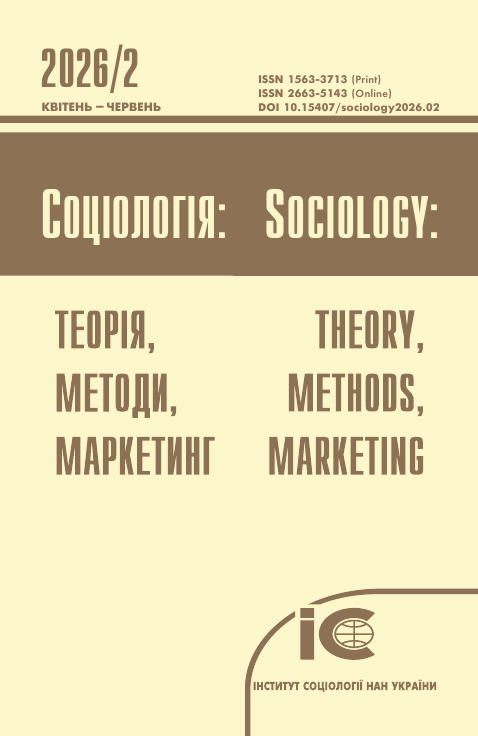
LATEST PRINTED ISSUE
LATEST FREELY ACCESSIBLE MATERIALS
East and West together? Why is it premature to talk about the end of regional differences?
stmm. 2026 (1): 188–193
DOI https://doi.org/10.15407/sociology2026.01.188
Full text: https://stmm.in.ua/archive/ukr/2026-1/14.pdf
VALENTYN HATSKO, PhD Student at the Faculty of Sociology, Taras Shevchenko National University of Kyiv, Research Fellow at the Center for Sociological Research, Study of Decentralization and Regional Development, Kyiv School of Economics (3, Mykoly Shpaka St., Kyiv, 02000)
valgat29@gmail.com
https://orcid.org/0009-0009-6572-9584
Since 2022, the public discourse has been dominated by the thesis that the full-scale war erased the traditional differences between eastern and western Ukraine, giving rise to an unprecedented national consolidation. This analysis challenges that thesis, drawing on representative survey data from 2022–2025. The results reveal a dual picture. On one hand, support for the Euro-Atlantic course and the refusal to make territorial concessions to Russia has indeed risen to record levels across the country. On the other hand, regional differences have not disappeared but transformed: they remain persistent in domains tied to cultural identity. The deepest gaps still run along the lines of language practices and interpretations of Soviet and recent history. Differences in the religious sphere and in attitudes toward language and cultural policy also remain profound. The author argues that the regional divide has not disappeared but splintered: linguistic, religious, and value-based positions no longer overlap. Accounting for this complexity is a necessary condition for the formation of an effective state policy aimed at strengthening national unity.
Keywords: regional differences, regional divide, national consolidation, cultural identity, language policy, Euro-Atlantic integration, public opinion, survey data, Russian-Ukrainian war, value orientations, religious identity, territorial concessions
Referenes:
-
DIF. (2023). Condemnation of the USSR, derussification, Maidan - how Ukrainians' attitudes toward national memory policy are changing against the backdrop of Russian aggression. [In Ukrainian]. Retrieved from: https://dif.org.ua/article/zasudzhennya-srsr-derusifikatsiya-maydan-yak-zminyuetsya-stavlennya-ukraintsiv-do-politiki-natsionalnoi-pamyati-na-tli-rosiyskoi-agresii
-
Gallup. (2024, November 18). Half of Ukrainians Want Quick, Negotiated End to War. Gallup.Com. [In Ukrainian]. Retrieved from: https://news.gallup.com/poll/653495/half-ukrainians-quick-negotiated-end-war.aspx
-
IRI. (2024, November 12). National Survey of Ukraine | Sept-Oct 2024. International Republican Institute. [In Ukrainian]. Retrieved from: https://www.iri.org/resources/national-survey-of-ukraine-sept-oct-2024/
-
KIIS. (2022a). Dynamics of evaluation of the activities of the OUN-UPA during the Second World War: The results of a telephone survey conducted on September 7-13, 2022. Retrieved from: https://kiis.com.ua/?cat=reports&id=1146&lang=eng&page=1&utm_source=chatgpt.com
-
KIIS. (2022b). Ukrainians' changing attitudes toward "traditional values": Results of a telephone survey conducted July 6-20, 2022. [In Ukrainian]. Retrieved from: https://www.kiis.com.ua/?lang=ukr&cat=reports&id=1128&page=1
-
KIIS. (2024). Perception of LGBT people and their rights in Ukraine: results of a telephone survey conducted on May 26-June 1, 2024. Retrieved from: https://www.kiis.com.ua/?cat=reports&id=1417&lang=eng&page=1&utm_source=chatgpt.com
-
KIIS. (2025a). Attitude towards individual language policy options in Ukraine. Retrieved from: https://www.kiis.com.ua/?cat=reports&id=1555&lang=eng&page=1&utm_source=chatgpt.com
-
KIIS. (2025b). Results of a nationwide poll by KIIS on war and peace. [In Ukrainian]. Retrieved from: https://kiis.com.ua/?lang=ukr&cat=reports&id=1551&page=1
-
Mironenko, T. (2023, March 15). Sociologist Volodymyr Paniotto on how a year of war has changed Ukrainians. Interview-Forbes.ua [In Ukrainian]. Retrieved from: https://forbes.ua/lifestyle/vtratiti-dokhodi-perezhiti-rozluku-pochuvatis-girshe-i-zalishitis-shchaslivimi-sotsiolog-volodimir-paniotto-pro-te-yak-ukraintsiv-zminiv-rik-viyni-15032023-12333
-
Rayevskiy, D., Kobernyk, K. (2023, November 16). "There were no real divisions in Ukraine before the full-scale invasion." Sociologist Tymofii Brik on social media fights, Ukrainian collectivism, and dialogue with Russians (video interview and key points). [In Ukrainian]. Retrieved from: https://babel.ua/texts/100705-do-povnomasshtabnogo-vtorgnennya-spravzhnih-rozkoliv-v-ukrajini-vzagali-ne-bulo-sociolog-timofiy-brik-pro-srachi-v-socmerezhah-kolektivizm-ukrajinciv-i-dialog-iz-rosiyanami-videointerv-yu-i-klyuchovi-tezy
-
Razumkov Center. (2024b). Ukrainian society, state, and church during the war. The church and religious situation in ukraine in 2024. [In Ukrainian]. Retrieved from: https://razumkov.org.ua/images/2025/01/28/2024-Religiya-religion-FIN.pdf
- Razumkov Centre. (2024a). Public support for Ukraine's accession to the European Union and NATO. Attitudes toward foreign countries. Attitudes toward peace negotiations (September 2024). [In Ukrainian]. Retrieved from: https://razumkov.org.ua/napriamky/sotsiologichni-doslidzhennia/pidtrymka-gromadianamy-vstupu-ukrainy-do-yevropeiskogo-soiuzu-ta-nato-stavlennia-do-inozemnykh-derzhav-stavlennia-do-myrnykh-peregovoriv-veresen-2024r
Received 15.12.2025
Accepted for publication after review 07.01.2026
East and West together? Why is it premature to talk about the end of regional differences?
stmm. 2026 (1): 188–193
DOI https://doi.org/10.15407/sociology2026.01.188
Full text: https://stmm.in.ua/archive/ukr/2026-1/14.pdf
VALENTYN HATSKO, PhD Student at the Faculty of Sociology, Taras Shevchenko National University of Kyiv, Research Fellow at the Center for Sociological Research, Study of Decentralization and Regional Development, Kyiv School of Economics (3, Mykoly Shpaka St., Kyiv, 02000)
valgat29@gmail.com
https://orcid.org/0009-0009-6572-9584
Since 2022, the public discourse has been dominated by the thesis that the full-scale war erased the traditional differences between eastern and western Ukraine, giving rise to an unprecedented national consolidation. This analysis challenges that thesis, drawing on representative survey data from 2022–2025. The results reveal a dual picture. On one hand, support for the Euro-Atlantic course and the refusal to make territorial concessions to Russia has indeed risen to record levels across the country. On the other hand, regional differences have not disappeared but transformed: they remain persistent in domains tied to cultural identity. The deepest gaps still run along the lines of language practices and interpretations of Soviet and recent history. Differences in the religious sphere and in attitudes toward language and cultural policy also remain profound. The author argues that the regional divide has not disappeared but splintered: linguistic, religious, and value-based positions no longer overlap. Accounting for this complexity is a necessary condition for the formation of an effective state policy aimed at strengthening national unity.
Keywords: regional differences, regional divide, national consolidation, cultural identity, language policy, Euro-Atlantic integration, public opinion, survey data, Russian-Ukrainian war, value orientations, religious identity, territorial concessions
Referenes:
-
DIF. (2023). Condemnation of the USSR, derussification, Maidan - how Ukrainians' attitudes toward national memory policy are changing against the backdrop of Russian aggression. [In Ukrainian]. Retrieved from: https://dif.org.ua/article/zasudzhennya-srsr-derusifikatsiya-maydan-yak-zminyuetsya-stavlennya-ukraintsiv-do-politiki-natsionalnoi-pamyati-na-tli-rosiyskoi-agresii
-
Gallup. (2024, November 18). Half of Ukrainians Want Quick, Negotiated End to War. Gallup.Com. [In Ukrainian]. Retrieved from: https://news.gallup.com/poll/653495/half-ukrainians-quick-negotiated-end-war.aspx
-
IRI. (2024, November 12). National Survey of Ukraine | Sept-Oct 2024. International Republican Institute. [In Ukrainian]. Retrieved from: https://www.iri.org/resources/national-survey-of-ukraine-sept-oct-2024/
-
KIIS. (2022a). Dynamics of evaluation of the activities of the OUN-UPA during the Second World War: The results of a telephone survey conducted on September 7-13, 2022. Retrieved from: https://kiis.com.ua/?cat=reports&id=1146&lang=eng&page=1&utm_source=chatgpt.com
-
KIIS. (2022b). Ukrainians' changing attitudes toward "traditional values": Results of a telephone survey conducted July 6-20, 2022. [In Ukrainian]. Retrieved from: https://www.kiis.com.ua/?lang=ukr&cat=reports&id=1128&page=1
-
KIIS. (2024). Perception of LGBT people and their rights in Ukraine: results of a telephone survey conducted on May 26-June 1, 2024. Retrieved from: https://www.kiis.com.ua/?cat=reports&id=1417&lang=eng&page=1&utm_source=chatgpt.com
-
KIIS. (2025a). Attitude towards individual language policy options in Ukraine. Retrieved from: https://www.kiis.com.ua/?cat=reports&id=1555&lang=eng&page=1&utm_source=chatgpt.com
-
KIIS. (2025b). Results of a nationwide poll by KIIS on war and peace. [In Ukrainian]. Retrieved from: https://kiis.com.ua/?lang=ukr&cat=reports&id=1551&page=1
-
Mironenko, T. (2023, March 15). Sociologist Volodymyr Paniotto on how a year of war has changed Ukrainians. Interview-Forbes.ua [In Ukrainian]. Retrieved from: https://forbes.ua/lifestyle/vtratiti-dokhodi-perezhiti-rozluku-pochuvatis-girshe-i-zalishitis-shchaslivimi-sotsiolog-volodimir-paniotto-pro-te-yak-ukraintsiv-zminiv-rik-viyni-15032023-12333
-
Rayevskiy, D., Kobernyk, K. (2023, November 16). "There were no real divisions in Ukraine before the full-scale invasion." Sociologist Tymofii Brik on social media fights, Ukrainian collectivism, and dialogue with Russians (video interview and key points). [In Ukrainian]. Retrieved from: https://babel.ua/texts/100705-do-povnomasshtabnogo-vtorgnennya-spravzhnih-rozkoliv-v-ukrajini-vzagali-ne-bulo-sociolog-timofiy-brik-pro-srachi-v-socmerezhah-kolektivizm-ukrajinciv-i-dialog-iz-rosiyanami-videointerv-yu-i-klyuchovi-tezy
-
Razumkov Center. (2024b). Ukrainian society, state, and church during the war. The church and religious situation in ukraine in 2024. [In Ukrainian]. Retrieved from: https://razumkov.org.ua/images/2025/01/28/2024-Religiya-religion-FIN.pdf
- Razumkov Centre. (2024a). Public support for Ukraine's accession to the European Union and NATO. Attitudes toward foreign countries. Attitudes toward peace negotiations (September 2024). [In Ukrainian]. Retrieved from: https://razumkov.org.ua/napriamky/sotsiologichni-doslidzhennia/pidtrymka-gromadianamy-vstupu-ukrainy-do-yevropeiskogo-soiuzu-ta-nato-stavlennia-do-inozemnykh-derzhav-stavlennia-do-myrnykh-peregovoriv-veresen-2024r
Received 15.12.2025
Accepted for publication after review 07.01.2026
LATEST PRINTED ISSUE
LATEST FREELY ACCESSIBLE MATERIALS